
Every dairy owner knows the tension of the tenth day. Farmers want their milk money, customers turn up to settle, and somewhere in a drawer is a register full of numbers that all have to add up. Do it by hand and one wrong total can eat an evening — and your trust. The good news is that a clean cycle is a routine, not a rescue mission. Do the same five steps every period and bill day gets boring, which is exactly what you want.
What a billing cycle is
A billing cycle is simply the stretch of time between two settlements. Most dairies run a 10-day or 15-day cycle — you buy and sell milk every day, and then on a fixed date you close the books and everyone squares up. There are always two sides to it. On the buy side you owe your farmers for the milk they delivered. On the sell side your customers owe you for the milk they took. A clean close means both sides are settled and every party's khata shows the right pending amount before the next period begins.
Step 1 — Pick the period
Start by choosing your date range. If you run a 10-day cycle, that might be the 1st to the 10th, the 11th to the 20th, and the 21st to the end of the month. Set the from-date and the to-date, and that's the window the whole settlement is built on. The dates matter: pick the same boundaries every time so a farmer never has to wonder whether a delivery landed in this bill or the last one.
Step 2 — Run the party-wise report
With the period set, run the party-wise report. For each farmer and each customer it pulls together everything from those ten days into one clean statement — total litres delivered, the average Fat and SNF, and the amount that adds up to. Instead of flipping through a register, you get one line per party with the full daily detail underneath. This is the single number you've been trying to reach with a calculator, produced in a second, the same way every time.
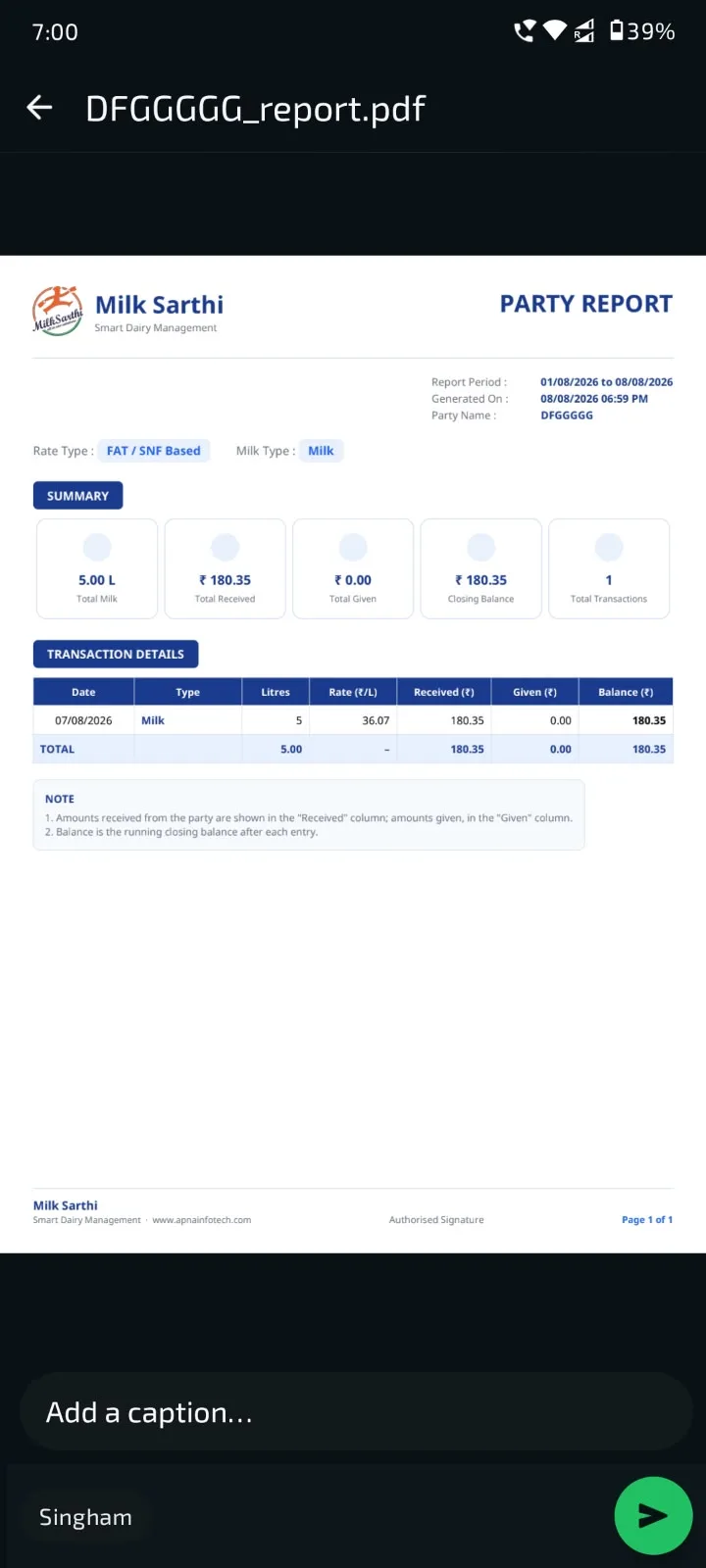
Step 3 — Share the PDF on WhatsApp
Once the report is ready, share it as a PDF on WhatsApp in one tap. The farmer or customer opens their phone and sees exactly the same numbers you're looking at — same litres, same Fat and SNF, same amount. No re-typing, no photographing a torn register page, no "let me check and call you back". When both sides read from the identical bill, the conversation moves straight to payment instead of doubt.
Step 4 — Record payments
Now the money moves. As each party pays you, or as you pay each farmer, enter what changed hands — the amount received from a customer, or the amount given to a farmer. The moment you record it, the balance updates itself. You never subtract by hand and you never keep a second tally of "who has paid" on a scrap of paper. Half-payments are fine too: pay a farmer part of the amount today and the running balance simply shows what is still due.
Step 5 — Reconcile balances
The last step is the one that keeps you honest: reconcile. After payments are in, every party has a closing balance — and that figure is the real pending amount, nothing hidden and nothing forgotten. If it reads zero, that party is fully settled. If it shows an amount, that is exactly what carries into the next cycle. Because the balance was built from the same entries you already shared, there is no separate reconciliation to do; you're just reading the truth off the screen. Want to see how the whole thing runs day to day before a full cycle? Our guide to the best dudh hisab app walks through it, and the plans page shows what's free.
Advances, feed and other dues
Not every rupee between you and a farmer is about milk. You give an advance before a festival; you sell a bag of cattle-feed on udhaar. These have no litres attached, so they don't belong in the milk report — they belong in the Khatabook, which handles pure credit and debit against each party. Record the advance as money given and the feed as a debit the farmer owes, and both flow into that party's running balance automatically. When you close the cycle, the farmer's closing figure is already the true net: milk earned, minus the feed and the advance, in one number. Nothing has to be worked out on the side, and nobody argues about a deduction they can see spelt out.
If you print bills or slips as well as sharing them, a small 52mm Bluetooth slip printer pairs neatly with the same report, so a farmer can walk away with a paper copy of the exact figures on their phone.
Key takeaways
- A clean cycle is a routine — the same five steps every 10 or 15 days, not a bill-day scramble.
- Run the party-wise report for the period: litres, average Fat/SNF and amount for every farmer and customer.
- Share the PDF on WhatsApp so both sides read from the identical bill.
- Record payments as they happen; the balance updates itself, no hand subtraction.
- The closing balance is the real pending amount — reconciled by design, nothing hidden.
- Put advances and cattle-feed in the Khatabook so the net figure is already correct.
When every farmer gets the same PDF on the same dates and every balance is one tap away, bill day stops being the hardest part of the month. That predictability is what a good cycle really buys you — fewer arguments, faster payments, and a khata you can trust.